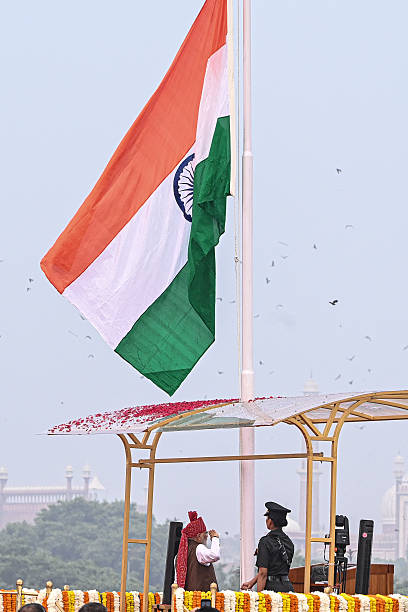
"This year's version was shorter than usual. It wasn't any less ambitious."
Modi mounted the ramparts of the Red Fort on Saturday for the thirteenth year running and gave his shortest Independence Day speech in four years: 75 minutes, against last year's 103-minute marathon. He didn't scale back the ambition to match. Marking 80 years of independence under the banner "Yuva Shakti for Viksit Bharat@2047," he packed in what might be the most economically dense Independence Day address of his tenure, alongside the political and ideological notes that have run through these speeches since 2014.
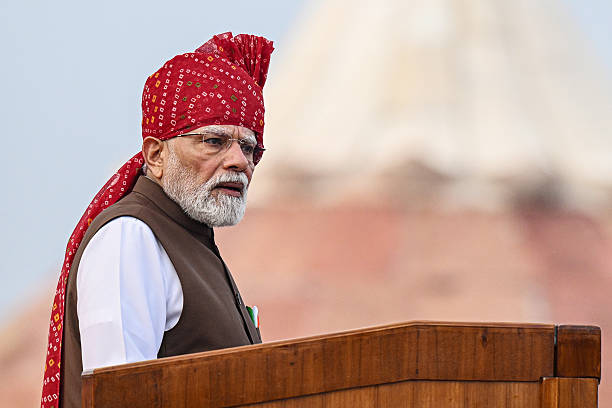
The Sapta Dhara framework
The organizing idea this year was "Shakti Ki Sapta Dhara," seven streams of strength: manufacturing, agriculture and food processing, technology and innovation, infrastructure (Gati Shakti), defence (Raksha Shakti), the green and blue economy, and soft power. Expect it to anchor government messaging for the next year, the way "Atmanirbhar Bharat" and "Amrit Kaal" have in previous phases. The name does some work on its own. It borrows the cadence of the ancient Sapta Sindhu to make a set of sectoral priorities sound like destiny rather than a list.
The substance underneath was more concrete than the branding. Modi said India has begun production at three semiconductor plants, with five to eight more expected over the next seven to eight years, evidence of a shift from chip design toward actual fabrication. He set a target of 100 gigawatts of nuclear capacity by 2047 and mentioned fast breeder reactor development, tying energy independence to technological independence. A new "Samudra Manthan" initiative for deep-sea resource mapping extends the same self-reliance argument to the ocean floor, an area where India has historically had little exploration capacity.
An ambitious claim that doesn't quite hold up
The line most likely to be picked apart is Modi's claim that India will achieve, in the next five to seven years, what it couldn't achieve in the previous five to seven decades. It flatters the current government while quietly writing off everything before it, a habit that's shown up in most of his Independence Day speeches. It's worth pushing back on this one directly: the claim squeezes seventy years of the Green Revolution, the IT boom, and telecom liberalization into a footnote so the present decade can look like the real beginning. Bold plans for the future are fair game in a speech like this. Treating the past as mere preamble is a different move, and it deserves scrutiny regardless of who's doing it.
Naxalism and the "Dimagi Naxal" line
On internal security, Modi said armed Naxalism has been almost entirely eliminated and paid tribute to the thousands of police and paramilitary personnel killed fighting the insurgency over the decades. He then introduced a more loaded term: "dimagi Naxals," roughly "Naxals of the mind," people he said still need to be identified and isolated even though the armed threat is mostly gone. This is where the speech is likely to generate lasting argument. Civil society groups have said for years that anti-terror and anti-Naxal laws sometimes get stretched to target journalists, academics, and activists who criticize government policy. Using insurgency language against an undefined category of "ideological" opponents, from the country's biggest political stage, invites that exact worry, whatever the Prime Minister actually meant by it.
Reform, and a target for corporate India
Modi repeated his call for regulatory modernization, arguing India can't handle 21st-century problems with 20th-century laws, and asked states to fall in line with the Centre on reform. That's a request that glosses over the federal friction such alignment usually causes in practice. He also set a target of fifty Indian companies reaching the Fortune 500, a goal that reflects real gains in Indian corporate scale over the past decade even if the number itself is more aspiration than policy.
Youth, sport, and the long game to 2036
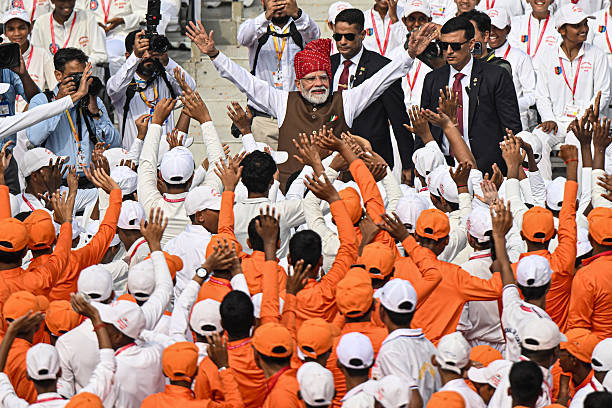
The rest of the speech leaned on generational appeal: an AI skilling programme for one crore young Indians, a talent search for athletes aged five to fifteen, and a formal restatement of India's bid to host the 2036 Olympics. Combined with "Vande Mataram" being performed at the Red Fort for the first time, in its 150th anniversary year, the speech was built to outlast the day's news cycle. It's aimed at 2036 for sport and 2047 for the developed-nation goal.
What was left out
What stood out by its absence was direct confrontation with Washington over tariffs and Russian oil purchases, a dispute that had dominated headlines in the days before the speech. References to the West Asia crisis and national security were present but restrained. On a ceremonial occasion like this, the government seems to have preferred projecting confidence over escalating rhetoric with a trading partner mid-negotiation.
The verdict
This speech was built for two audiences at once: domestic voters looking for signs of real economic progress, and outside observers trying to figure out whether India's self-reliance push is substance or slogan. The semiconductor and nuclear numbers point to actual institutional follow-through. The "five years versus seven decades" line and the "dimagi Naxal" phrase point to a government still willing to use the Independence Day platform for partisan scoring dressed up as national unity. Both can be true of the same speech, and each deserves to be judged on its own rather than collapsed into a single verdict of triumph or failure.
Eighty years in, the Red Fort address is still what it's always been: part governance roadmap, part campaign speech, part sermon on national identity. This year's version was shorter than usual. It wasn't any less ambitious.